

Quick answer
OpenAI Realtime API is a strong foundation if you are building a custom low-latency audio product. ChatGPT is excellent when you need a general AI assistant for writing, reasoning, files, images, research, or voice conversations. AudioDich is different: it is built for people who want translated subtitles, transcripts, and live call translation without building an app first.
This comparison is not about dismissing OpenAI. The official Realtime docs describe dedicated translation sessions that stream source audio and return translated audio plus transcript deltas while the speaker is still talking. That is powerful. The question is whether you need a developer platform, a general assistant, or a ready-to-use live translation process.
What each product is best at
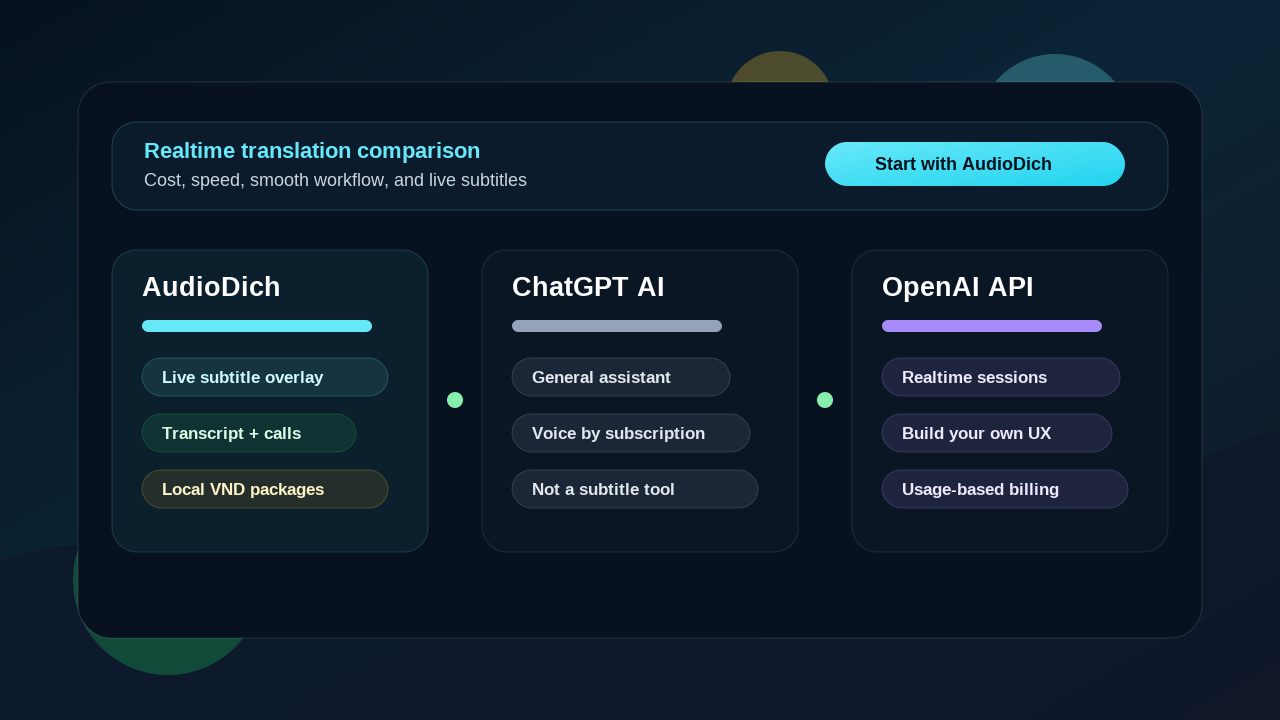
- ChatGPT AI: best for general assistant work such as writing, analysis, reasoning, brainstorming, file workflows, and conversational voice.
- OpenAI Realtime API: best for developers who need to build custom voice agents, live translation, streaming transcription, WebRTC, WebSocket, and media pipelines.
- AudioDich: best for users who need realtime subtitles, transcripts, call rooms, browser audio capture, desktop workflows, Vietnamese TTS, and predictable VND-based packages.
ChatGPT is a broad AI app. It is not designed as a universal subtitle overlay for YouTube, Netflix, webinars, or social live streams. The Realtime API can power such a product, but the product still has to be built. AudioDich focuses on the finished experience.
Cost comparison
Price-per-hour table for live translation
| Criteria | ChatGPT AI | OpenAI Realtime API | AudioDich |
|---|---|---|---|
| Effective cost for live translation only | Plus is 20 USD/month. If you only use about 5 hours of live translation each month, your effective cost is 4 USD/hour. Pro at 100-200 USD/month is higher if you only need live subtitles. | gpt-realtime-translate is 0.034 USD/minute for output, about 2.04 USD/hour before app, transcript storage, UI, operations, and support costs. | 29,000 VND/2 hours, the 59,000 VND Pro package, 129,000 VND/12 hours, and 259,000 VND/25 hours, roughly 0.39-0.41 USD/hour for the 12- and 25-hour packages using an approximate 26,300 VND/USD reference rate. |
| Ready-to-use process | Not a universal subtitle overlay for every tab or video platform. | Powerful, but your team still has to build audio capture, sessions, subtitles, billing, and dashboards. | Open content, select languages, start realtime subtitles, save transcripts, use call rooms, Chrome Extension, and desktop workflows. |
| Live translation quality | Strong general AI quality, but not focused on subtitle overlays, included time, and call transcript management. | Strong platform quality, with final quality depending on the product your team builds. | Strong practical quality for clear meetings, videos, and livestreams, with a process close to the ChatGPT voice experience but much cheaper for live translation. |
| Best choice | Broad AI assistant across many tasks. | Custom product development with engineering budget. | Low cost, good quality, and immediate live translation for YouTube, Netflix, webinars, meetings, and international calls. |
The key point is effective hourly cost. ChatGPT Plus does not publish an hourly price, but if a customer only uses about 5 hours of live translation per month, 20 USD/month works out to 4 USD per actual hour used. AudioDich packages stay far cheaper per hour than ChatGPT Plus either way, at about 10,750 VND/hour on the 12-hour package and about 10,360 VND/hour on the 25-hour package, while staying focused on subtitles, transcripts, and live translation.
OpenAI Help states that ChatGPT Plus is 20 USD per month. OpenAI Help also describes Pro tiers at 100 USD and 200 USD per month for heavier usage. Those plans make sense when you use many ChatGPT capabilities, not just live translation.
For someone who only needs a few hours of translated subtitles each week, a broad monthly subscription can be more than the actual need. AudioDich uses time-based packages in VND: a free 20-minute first-login trial, 29,000 VND for 2 hours, 59,000 VND for the Pro package, 129,000 VND for 12 hours, and 259,000 VND for 25 hours. That makes the decision simpler for Vietnamese users and small teams.
The OpenAI API pricing page currently lists `gpt-realtime-translate` at 0.034 USD per minute for output. That is platform pricing, not a complete app price. A real product also needs authentication, audio capture, UI, subtitles, transcripts, storage, billing, support, monitoring, and error recovery.
Speed and smoothness
The Realtime API is designed for low-latency audio. OpenAI recommends realtime sessions for live audio and WebRTC for browser media when appropriate. That is a technical advantage for builders.
End users, however, feel the whole process, not just model latency. They care about how fast they can start, whether subtitles appear where the video is playing, whether transcripts are saved, whether the call continues smoothly, and whether they can recover from noisy audio or a tab change.
AudioDich optimizes this practical smoothness. The Chrome Extension fits browser video. The web app and call rooms support meetings. The desktop app helps with audio sources outside the browser. The user does not need to manage API keys, client secrets, WebRTC details, or streaming events.
When ChatGPT is better
Choose ChatGPT when you want an all-purpose AI assistant. It is better for explaining ideas, writing messages, analyzing files, planning work, creating images, or continuing a conversation with AI voice. If you already use ChatGPT daily for many tasks, Plus or Pro can be worth the monthly subscription.
AudioDich is not trying to replace every ChatGPT process. It focuses on translating what other people are saying in real time and saving that content as subtitles and transcripts.
When OpenAI Realtime API is better
Choose OpenAI Realtime API when you have a technical team and need to build your own product. It is suitable for custom voice agents, embedded interpreters, call-center media pipelines, SIP or broadcast ingest, internal tools, and domain-specific workflows.
The tradeoff is implementation work. You need servers, session creation, API key protection, audio handling, event processing, UI, billing, analytics, and customer support. AudioDich is valuable when you want to skip that build phase and use live translation immediately.
Why AudioDich is stronger for Vietnamese live translation users
AudioDich is priced locally, localized for Vietnamese users, and centered on live translation. It supports subtitles, transcripts, calls, TTS, browser usage, and desktop scenarios in one process. That focus matters when the user simply wants to understand a live stream, class, meeting, interview, documentary, or social video.
The product is also practical for research, marketing, sales, customer support, education, and creators. You can follow the content live, review the transcript later, copy key points, and share takeaways with a team.
Official references
- OpenAI Realtime and audio guide: https://developers.openai.com/api/docs/guides/realtime
- OpenAI Realtime translation guide: https://developers.openai.com/api/docs/guides/realtime-translation
- OpenAI API pricing: https://developers.openai.com/api/docs/pricing
- ChatGPT Plus help article: https://help.openai.com/en/articles/6950777-what-is-chatgpt-plus
- ChatGPT Pro tiers help article: https://help.openai.com/en/articles/9793128-what-is-chatgpt-team
Conclusion
Use ChatGPT for broad AI assistance. Use OpenAI Realtime API when you want to build. Use AudioDich when you want live translation now, with fewer steps, readable subtitles, saved transcripts, and pricing that is easier to match to real Vietnamese usage.