

Quick answer
Handheld translator devices and translator earbuds can be useful. They make sense for travel, front desks, clinics, airports, factories, tourism counters, retail service, and situations where a company wants one dedicated device instead of asking staff to use personal phones. Some models include mobile data. Some support limited offline packages. Some have good microphones, speakers, and simplified buttons.
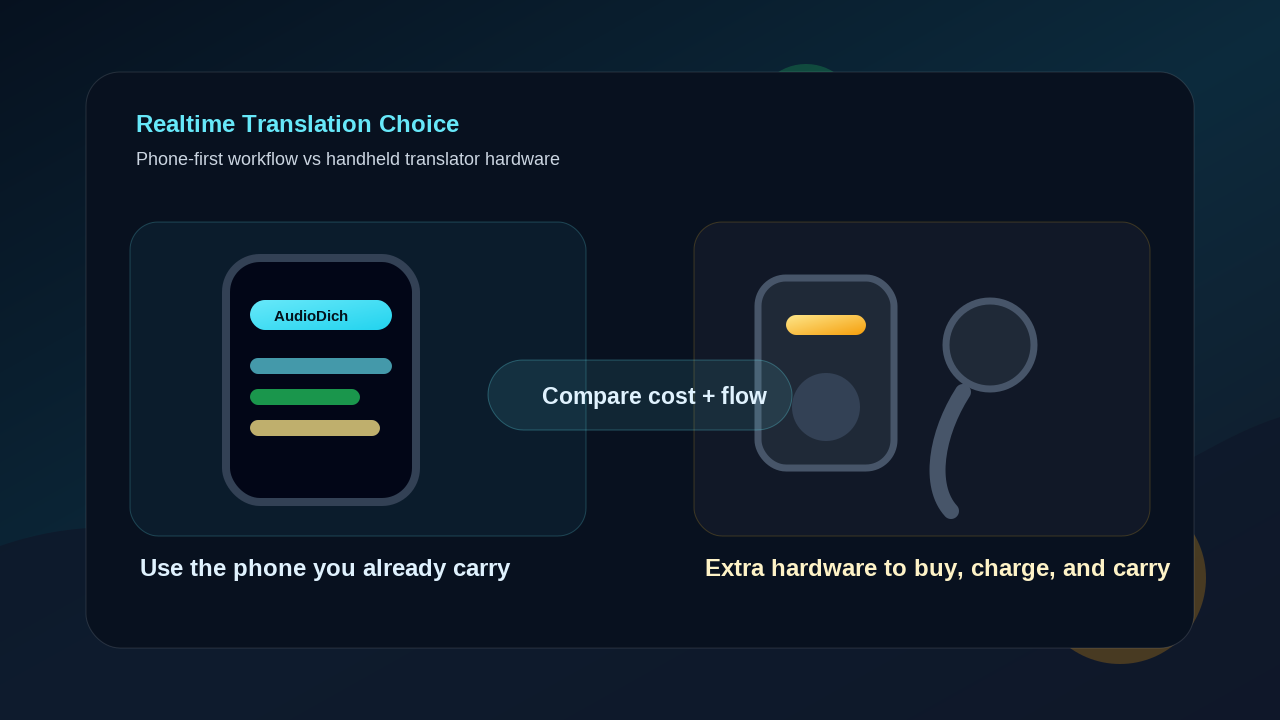
The question changes when the main task is not street conversation but digital content. If you need to understand YouTube, Netflix, webinars, online classes, Zoom, Google Meet, Microsoft Teams, livestreams, podcasts, or product demos, the best process is usually not another gadget. It is a translation layer that runs on the phone, browser, laptop, or desktop you already use.
AudioDich is built for that process. It focuses on realtime subtitles, transcripts, call rooms, browser use, desktop use, Vietnamese TTS, and clear VND packages. You do not need to buy hardware first. You can start with 20 minutes on first login + 10 minutes daily, then choose a small time package if the process fits.
Fast comparison
| Factor | Translator devices and interpreter earbuds | AudioDich |
|---|---|---|
| Upfront cost | Dedicated hardware is usually required. Pocketalk lists S2/S2 Plus at 299.95-349.95 USD, Vasco V4 at 449 USD, Timekettle X1 at 699.99 USD, while common Timekettle earbuds range roughly from 119-449 USD depending on model and sale. | Free 20-minute first-login trial. Paid packages currently range from 29,000 VND for 2 hours to 259,000 VND for 25 hours, with the 25-hour package at about 10,360 VND per hour. No extra hardware. |
| Device burden | You carry a translator, earbuds, charging case, cable, and sometimes accessories. If it is forgotten, drained, or broken, the process stops. | You use the phone, laptop, browser, or desktop already in your workday. |
| Start speed | Turn on the device, connect network or app, choose mode, hand it over or wear earbuds correctly. | Open AudioDich, choose languages, start realtime translation. This is smoother when the content already lives on your device. |
| Digital content | Good for face-to-face conversation, but not always natural for long videos, tabs, webinars, captions, and saved transcripts. | Built for realtime subtitles, transcripts, call rooms, Chrome Extension, web app, and desktop workflows. |
| Network | Most high-quality voice translation still depends on internet. Offline packages are usually narrower than online coverage. | Also needs internet for best realtime translation, but uses the connection your phone or laptop already has. |
| Best fit | Travel, service counters, environments that require a separate shared device. | Online learning, meetings, YouTube, Netflix, livestreams, webinars, research, creators, and daily laptop work. |
Cost: hardware has a high starting price
Dedicated translators are not just software. The price includes screen, microphones, speakers, battery, casing, firmware, logistics, warranty, retail margin, bundled data, and companion apps. That is why many products sit in the few-hundred-dollar range.
Official product pages show the pattern clearly. Pocketalk S2 and S2 Plus are listed at 299.95 USD and 349.95 USD with 92+ language translation, camera translation, and a five-year data plan. Vasco Translator V4 is listed at 449 USD and promotes 112 photo languages, 107 text languages, 82 voice languages, and free lifetime connectivity. Timekettle products span from lower-cost earbuds to the X1 Interpreter Hub at 699.99 USD, with different modes for one-on-one, calls, media translation, and meetings.
At the May 14, 2026 reference rate of about 26,350 VND per USD, 299.95 USD is close to 7.9 million VND, 449 USD is about 11.8 million VND, and 699.99 USD is about 18.4 million VND. That can be reasonable for heavy daily use, but it is expensive if you only need a few classes, calls, livestreams, or videos each month.
AudioDich is time-based. You can test with 20 minutes on first login + 10 minutes daily, buy 2 hours for 29,000 VND, the Pro package for 59,000 VND, 12 hours for 129,000 VND, or 25 hours for 259,000 VND. The 12-hour package costs about 10,750 VND per hour, while the 25-hour package sits at about 10,360 VND per hour, for people who want more hours in one purchase. For many Vietnamese users, the economic choice is straightforward: pay for actual usage first, then buy hardware only if a dedicated device is clearly needed.
Smoothness is more than translation latency
A device may translate quickly after it hears a sentence, but real process speed includes setup. You take it out, turn it on, check battery, connect network, choose languages, select mode, place the microphone correctly, ask the other person to wait, and sometimes hand the device back and forth.
This is acceptable for a counter or travel conversation. It is less natural for a long YouTube lecture, webinar, product launch, livestream, or meeting. Digital content is already inside a browser or app. Adding another physical microphone between the speaker and the listener can make the flow feel slower.
AudioDich reduces that gap. The translation layer is on the same device where you watch, learn, or work. Subtitles are easier to read than a small translator screen. Transcripts remain available after the session. For long content, this matters more than a small difference in raw model latency.
Network reality
Many buyers assume translator hardware works well without internet. Some devices include mobile data, and some provide offline packs for selected language pairs. Those features are valuable. They do not remove the general rule: broad, high-quality voice translation usually works best with cloud connectivity.
Vasco says voice translators rely on network connectivity while offering its own lifetime connectivity. Pocketalk promotes built-in LTE data and Wi-Fi or hotspot options. Timekettle lists online and offline modes, but the offline list is narrower than the online language set.
AudioDich also needs internet for the best realtime result. The advantage is that, for YouTube, Netflix, webinars, and online meetings, you already need internet to access the content. AudioDich uses the same phone or laptop connection instead of asking you to maintain a second internet-enabled device.
When hardware is still better
Choose a dedicated translator if the job is mostly face-to-face: asking directions, restaurant orders, hotel reception, retail service, patient intake, factory floor communication, or a shared business counter. Hardware can also be easier when a company does not want employees to use personal phones.
Choose AudioDich when the source is digital: online classes, meetings, livestreams, video platforms, webinars, podcasts, product demos, research calls, and long recordings. In those situations you need subtitles, transcripts, and a low-friction process more than a separate screen and speaker.
Why AudioDich is cheaper without being weaker for this need
AudioDich does not sell screens, batteries, shipping, plastic shells, or charging cases. The product cost is focused on realtime translation, captions, transcript storage, call rooms, TTS, web experience, and support. That lets AudioDich price the service in small VND packages that match local usage.
Lower cost does not mean lower practical value. It means the product is focused. For digital content, a large readable subtitle and saved transcript often matter more than a standalone device. For Vietnamese users who only need live translation a few hours per week, AudioDich can solve the real problem at a fraction of the hardware cost.
Conclusion
Translator devices are useful for travel, counters, and face-to-face service. They also cost more upfront, require charging, require another item to carry, and still need network connectivity for the best results. AudioDich is stronger when the content already lives on your phone, browser, laptop, or meeting app.
If you are considering a translator device mainly for videos, online classes, livestreams, Netflix, YouTube, webinars, or meetings, try AudioDich first. You may find that the best translator is not another gadget, but realtime subtitles and transcripts on the device you already use every day.
Sources
- Pocketalk device page: https://pocketalk.com/device
- Timekettle M3 and WT2 Edge comparison: https://www.timekettle.co/products/m3-travel-translator-earbuds
- Timekettle X1 AI Interpreter Hub page: https://www.timekettle.co/en-inter/products/x1-ai-interpreter-hub-k
- Vasco Translator V4 page: https://vasco-translator.com/translators/vasco-translator-v4
- USD/VND reference on 2026-05-14: https://www.exchange-rates.org/converter/usd-vnd